Markets
Forex Trading
Trade the Markets with Titanium
Foreign exchange trading is a core offering at Titanium.
Our pricing technology sources competitive quotes from a broad network of liquidity providers to deliver efficient market access.
By continuously monitoring pricing quality, Titanium aims to ensure traders benefit from consistent and competitive trading conditions.
Benefits of Forex Trading
Trade currency markets with competitive pricing and access to major global pairs such as EUR/USD, GBP/USD, AUD/USD, USD/CHF, USD/JPY, and USD/CAD.
Efficient Trading Conditions
Take both long and short positions in the forex market
Trade forex markets 24 hours a day, five days a week
Wide range of FX pairs; Majors, minors & exotics
Start trading with flexible position sizes using micro lots
Compare Our Account Features
Standard
Raw
Spread From
0.9 Pips
0.0 Pips
Commission
$0
$3.5 (Per Side)
Starting Deposit
$50
$50
Server Location
New York
New York
Micro lot trading (0.01)
Range of Markets
Access to 150+ global markets including FX, Indices, Commodities, Digital Currencies and more.
Access to 150+ global markets including FX, Indices, Commodities, Digital Currencies and more.
One Click Trading
Trading Styles Allowed
All
All
Order Distance Restriction
None
None
Suitable For
All Traders
All Traders
Forex Trading Conditions
Explore Titanium’s trading conditions across our full range of instruments to see how our environment supports your trading strategy.
Spreads
Titanium offers competitive spreads through access to deep liquidity and efficient pricing infrastructure.
Margin & Leverage
Leverage options may vary depending on your jurisdiction and the Titanium entity you trade with, providing flexibility to suit different trading approaches.
Swap Fees
Overnight financing rates are sourced through our liquidity network to ensure competitive market-based pricing across our available instruments.
FAQs
Forex refers to the global market where currencies are exchanged and is widely recognized as the most liquid financial market worldwide.
Trading forex involves exchanging one currency for another, with prices influenced by supply and demand. Currencies are traded in pairs, where the value of one is measured against the other.
For example, in the pair AUD/USD, the Australian dollar is valued against the US dollar. Buying one standard lot of AUD/USD means purchasing 100,000 Australian dollars while simultaneously exchanging the equivalent value in US dollars.
Trading with leverage allows you to access greater market exposure than your account balance alone would normally permit.
To open leveraged positions, a portion of your funds is required as collateral — this is known as margin. Margin enables you to participate in larger market positions while using a smaller amount of capital.
For more details, please refer to our margin information section.
Leverage levels available to you may vary depending on the Titanium entity with which you open your account. Please refer to the leverage section for full details.
The forex market operates nearly 24 hours a day, five days a week, opening on Sunday evening and closing on Friday evening (New York time).
Trading platform charts are set to GMT+3 during daylight saving time and GMT+2 outside of daylight saving time.
Commissions apply to selected instruments such as FX, metals, and digital assets. Commission rates are competitive and vary by asset class.
Certain instruments, including indices, commodities, and other products, may be traded without commission.
With Titanium, you can trade FX using MetaTrader 5 on desktop, mobile, and web platforms, allowing you to access the markets from anywhere.
Titanium offers competitive forex spreads across a wide range of currency pairs. You can view average spread details in the Trading Conditions section.
The maximum trade size available for FX pairs is up to 1000 lots per position.
The minimum trade size for FX positions is 0.01 lots.
Crypto CFDs
Trade Digital Assets with Titanium
Titanium offers access to a wide selection of cryptocurrency CFDs, allowing you to participate in the digital asset market with competitive pricing.
Trade popular cryptocurrencies with the flexibility to take both long and short positions, all within a structured trading environment designed for efficiency and accessibility.
Trade Titan vs Other Crypto CFD Platforms
Trade Titanium
Coinbase
CoinSpot
CoinSpot
Minimum Deposit
$0
$50*
$1
$0 or $50
Demo Account
Yes
No
No
No
Bitcoin Trading Fees
0.1%
1.99%/1.99% (Maker/Taker)
1%
0.1%/0.1% (Maker/Taker)
Leverage Available
Yes^
No
No
No
FAQs
Unlike traditional cryptocurrency purchases where you simply buy and hold the asset, trading crypto CFDs allows you to speculate on price movements without owning the underlying asset.
With crypto CFDs, you can take both long and short positions, and you may also use leverage to gain greater market exposure without committing additional capital.
At Titanium, we aim to keep trading costs competitive, with crypto trading commissions set at 0.1% per trade.
Positions held overnight may incur a financing charge, calculated at the platform’s daily rollover time. These rates are updated regularly and can be viewed directly within your MetaTrader terminal.
Yes, you can start by practicing with a Titanium demo account. Simply log in to your client dashboard and open a demo account in just a few clicks.
Indices
Trade Index CFDs with Titanium
Titanium provides access to a range of Index CFDs with competitive pricing and efficient execution.
With the flexibility to take both long and short positions, traders can respond to broader market trends using leveraged exposure within a structured trading environment.
Index CFDs are available with zero commission trading.
Benefits of Trading Indices
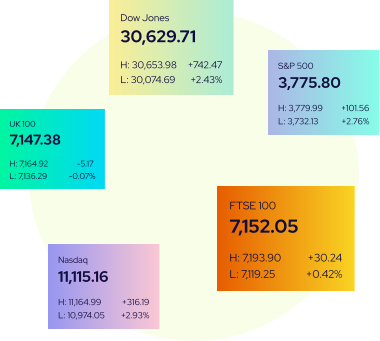
Trade index CFDs with leveraged exposure and competitive spreads. Access widely followed indices such as the S&P 500, GER40, UK100, and more.
Efficient Market Access
Gain exposure to an entire market segment through a single trade
Use index trading as part of broader portfolio strategies
Trade market performance without the need to hold individual shares
Why Trade Index CFDs?
Index CFDs allow you to gain exposure to major global stock markets without needing to own the underlying shares.
Indices such as the US30 represent a basket of leading companies, reflecting the overall performance of key market sectors. By trading these instruments as CFDs, you can take positions based on your market outlook.
Major indices are also widely used as indicators of broader market sentiment, helping traders understand prevailing trends and risk conditions.
FAQs
If a position is held prior to an index’s ex-dividend date, a dividend adjustment may apply.
To be eligible, the position must remain open through the ex-dividend date. Long positions typically receive a dividend adjustment, while short positions may be charged accordingly.
Index CFDs are cash-based instruments and may be subject to daily financing charges for positions held overnight.
To account for the weekend, a three-day financing adjustment is typically applied to open positions at the end of the trading week.
CFD pricing is derived from a network of liquidity providers who estimate fair value based on underlying market conditions, while factoring in elements such as market exposure and hedging considerations.
Indices reflect the performance of a group of companies listed on a particular exchange.
For example, some indices track the largest companies within a specific market, providing a snapshot of overall market performance. Index CFDs are derivative instruments that follow the value of these underlying markets, allowing traders to speculate on price movements without owning the underlying assets.
CFD trading involves significant risk. Because leverage allows you to control positions larger than your initial capital, losses can occur rapidly and may exceed your account balance.
Leverage levels may vary depending on the Titanium entity with which you hold your account. Please refer to the leverage section for more details.
Market conditions may differ outside of regular trading hours, and spreads can widen during these periods.
As underlying markets may be closed or experience reduced liquidity, pricing is based on fair value estimates of the relevant markets. Traders should remain mindful of potential volatility when trading outside standard market hours.
As with other CFD products, positions held overnight may be subject to a swap or financing adjustment at the daily rollover time.
The maximum trade size per position is 1000 lots. Larger exposure can be achieved by placing multiple trades.
The minimum trade size for most index positions is 0.10 lots. Certain indices may have a higher minimum trade size requirement.
Index trading hours generally align with the operating hours of their respective underlying markets.
For example, each index follows the schedule of the exchange it represents. Please refer to the Market Hours section for full details.
Each index point typically corresponds to one unit of the instrument’s base currency.
Titanium offers competitive CFD spreads across a range of index products. Average spread details are available in the Trading Conditions section.
Dividend adjustments may be applied after the ex-dividend date and will either be credited or debited depending on your position.
Commodities
Trade Commodity CFDs with Titanium
Titanium is committed to providing competitive pricing across its range of commodity products.
By sourcing prices through a network of liquidity providers and continuously monitoring market conditions, Titanium aims to deliver consistent and efficient pricing across metals and other commodity instruments.
Benefits of Trading Commodities
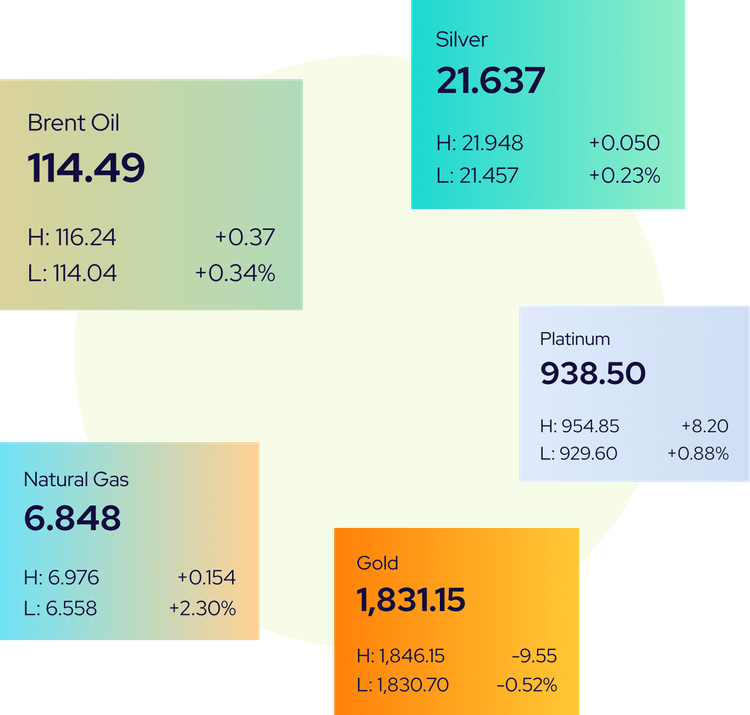
Trade global commodity markets with competitive spreads and access a range of widely traded instruments.
Efficient Commodity Trading
Commodities can support portfolio diversification
Often exhibit low or negative correlation with traditional assets
Markets are widely followed and offer transparent pricing
What is Commodities Trading?
Commodities trading involves buying or selling raw materials such as metals, energy products, or agricultural goods in order to benefit from price movements.
These markets are often influenced by global economic developments, geopolitical events, and changes in supply and demand, which can create opportunities for traders.
FAQs
Commodity markets are often favored by traders due to their potential for strong trends and price movements driven by global economic factors, geopolitical developments, and shifts in supply and demand.
These characteristics can create both opportunities and risks, making commodities an attractive market for experienced traders.
Trading commodities with Titanium is similar to trading FX. Instead of exchanging one currency against another, you trade units of a commodity priced against the US dollar.
Commodity markets typically operate nearly 24 hours a day during the trading week, and positions held overnight may be subject to financing adjustments.
Available commodity markets may include metals, energy products, and agricultural instruments.
Energy Pricing
Energy CFDs are structured as continuous, non-expiring instruments that reflect an estimated spot value derived from relevant underlying futures pricing.
Metals & Agricultural Pricing
Pricing for metals and agricultural commodities is based on underlying futures market data, designed to reflect fair market value across contract periods.
Commodity trading is offered exclusively through CFDs, which are cash-settled instruments and do not involve physical delivery of the underlying asset.
WTI represents a widely traded benchmark for crude oil pricing based on the West Texas Intermediate blend.
Brent Crude is another key global benchmark, commonly used to reflect oil pricing in international markets.
Pricing is derived from underlying futures market data, taking into account factors such as time to contract expiry, liquidity conditions, and market volatility to reflect fair value.
Trading Accounts
Trading Instruments
Trading Platforms
Trade Titanium
Customer Notice
Trading derivatives carries a high level of risk to your capital and you should only trade with money you can afford to lose. Any information or advice contained on this website is general in nature and has been prepared without taking into account your objectives, financial situation, or needs. Past performance of any product described on this website is not a reliable indication of future performance. You should review all relevant legal documentation to ensure you fully understand the risks before making any trading decisions. We encourage you to seek independent advice if necessary. The information on this website is not intended to be an inducement, offer, or solicitation to any person in any country or jurisdiction where such distribution or use would be contrary to local law or regulation.
Trade Titanium, Inc is registered in the State of Georgia, United States as a Foreign Profit Corporation with registration number 12074807. The company operates globally in accordance with applicable laws and compliance standards.
© Copyright 2012–2026 Trade Titanium, Inc. All rights reserved.
All trademarks, service marks, trade names, trade dress, product names, and logos appearing on this site are the property of their respective owners.
Markets
Forex Trading
Trade the Markets with Titanium
Foreign exchange trading is a core offering at Titanium.
Our pricing technology sources competitive quotes from a broad network of liquidity providers to deliver efficient market access.
By continuously monitoring pricing quality, Titanium aims to ensure traders benefit from consistent and competitive trading conditions.
Benefits of Forex Trading
Trade currency markets with competitive pricing and access to major global pairs such as EUR/USD, GBP/USD, AUD/USD, USD/CHF, USD/JPY, and USD/CAD.
Efficient Trading Conditions
Take both long and short positions in the forex market
Trade forex markets 24 hours a day, five days a week
Wide range of FX pairs; Majors, minors & exotics
Start trading with flexible position sizes using micro lots
Compare Our Account Features
Standard
Raw
Spread From
0.9 Pips
0.0 Pips
Commission
$0
$3.5 (Per Side)
Starting Deposit
$50
$50
Server Location
New York
New York
Micro lot trading (0.01)
Range of Markets
Access to 150+ global markets including FX, Indices, Commodities, Digital Currencies and more.
Access to 150+ global markets including FX, Indices, Commodities, Digital Currencies and more.
One Click Trading
Trading Styles Allowed
All
All
Order Distance Restriction
None
None
Suitable For
All Traders
All Traders
Forex Trading Conditions
Explore Titanium’s trading conditions across our full range of instruments to see how our environment supports your trading strategy.
Spreads
Titanium offers competitive spreads through access to deep liquidity and efficient pricing infrastructure.
Margin & Leverage
Leverage options may vary depending on your jurisdiction and the Titanium entity you trade with, providing flexibility to suit different trading approaches.
Swap Fees
Overnight financing rates are sourced through our liquidity network to ensure competitive market-based pricing across our available instruments.
FAQs
Forex refers to the global market where currencies are exchanged and is widely recognized as the most liquid financial market worldwide.
Trading forex involves exchanging one currency for another, with prices influenced by supply and demand. Currencies are traded in pairs, where the value of one is measured against the other.
For example, in the pair AUD/USD, the Australian dollar is valued against the US dollar. Buying one standard lot of AUD/USD means purchasing 100,000 Australian dollars while simultaneously exchanging the equivalent value in US dollars.
Trading with leverage allows you to access greater market exposure than your account balance alone would normally permit.
To open leveraged positions, a portion of your funds is required as collateral — this is known as margin. Margin enables you to participate in larger market positions while using a smaller amount of capital.
For more details, please refer to our margin information section.
Leverage levels available to you may vary depending on the Titanium entity with which you open your account. Please refer to the leverage section for full details.
The forex market operates nearly 24 hours a day, five days a week, opening on Sunday evening and closing on Friday evening (New York time).
Trading platform charts are set to GMT+3 during daylight saving time and GMT+2 outside of daylight saving time.
Commissions apply to selected instruments such as FX, metals, and digital assets. Commission rates are competitive and vary by asset class.
Certain instruments, including indices, commodities, and other products, may be traded without commission.
With Titanium, you can trade FX using MetaTrader 5 on desktop, mobile, and web platforms, allowing you to access the markets from anywhere.
Titanium offers competitive forex spreads across a wide range of currency pairs. You can view average spread details in the Trading Conditions section.
The maximum trade size available for FX pairs is up to 1000 lots per position.
The minimum trade size for FX positions is 0.01 lots.
Crypto CFDs
Trade Digital Assets with Titanium
Titanium offers access to a wide selection of cryptocurrency CFDs, allowing you to participate in the digital asset market with competitive pricing.
Trade popular cryptocurrencies with the flexibility to take both long and short positions, all within a structured trading environment designed for efficiency and accessibility.
Trade Titan vs Other Crypto CFD Platforms
Trade Titanium
Coinbase
CoinSpot
CoinSpot
Minimum Deposit
$0
$50*
$1
$0 or $50
Demo Account
Yes
No
No
No
Bitcoin Trading Fees
0.1%
1.99%/1.99% (Maker/Taker)
1%
0.1%/0.1% (Maker/Taker)
Leverage Available
Yes^
No
No
No
FAQs
Unlike traditional cryptocurrency purchases where you simply buy and hold the asset, trading crypto CFDs allows you to speculate on price movements without owning the underlying asset.
With crypto CFDs, you can take both long and short positions, and you may also use leverage to gain greater market exposure without committing additional capital.
At Titanium, we aim to keep trading costs competitive, with crypto trading commissions set at 0.1% per trade.
Positions held overnight may incur a financing charge, calculated at the platform’s daily rollover time. These rates are updated regularly and can be viewed directly within your MetaTrader terminal.
Yes, you can start by practicing with a Titanium demo account. Simply log in to your client dashboard and open a demo account in just a few clicks.
Indices
Trade Index CFDs with Titanium
Titanium provides access to a range of Index CFDs with competitive pricing and efficient execution.
With the flexibility to take both long and short positions, traders can respond to broader market trends using leveraged exposure within a structured trading environment.
Index CFDs are available with zero commission trading.
Benefits of Trading Indices
Trade index CFDs with leveraged exposure and competitive spreads. Access widely followed indices such as the S&P 500, GER40, UK100, and more.
Efficient Market Access
Gain exposure to an entire market segment through a single trade
Use index trading as part of broader portfolio strategies
Trade market performance without the need to hold individual shares
Why Trade Index CFDs?
Index CFDs allow you to gain exposure to major global stock markets without needing to own the underlying shares.
Indices such as the US30 represent a basket of leading companies, reflecting the overall performance of key market sectors. By trading these instruments as CFDs, you can take positions based on your market outlook.
Major indices are also widely used as indicators of broader market sentiment, helping traders understand prevailing trends and risk conditions.
FAQs
If a position is held prior to an index’s ex-dividend date, a dividend adjustment may apply.
To be eligible, the position must remain open through the ex-dividend date. Long positions typically receive a dividend adjustment, while short positions may be charged accordingly.
Index CFDs are cash-based instruments and may be subject to daily financing charges for positions held overnight.
To account for the weekend, a three-day financing adjustment is typically applied to open positions at the end of the trading week.
CFD pricing is derived from a network of liquidity providers who estimate fair value based on underlying market conditions, while factoring in elements such as market exposure and hedging considerations.
Indices reflect the performance of a group of companies listed on a particular exchange.
For example, some indices track the largest companies within a specific market, providing a snapshot of overall market performance. Index CFDs are derivative instruments that follow the value of these underlying markets, allowing traders to speculate on price movements without owning the underlying assets.
CFD trading involves significant risk. Because leverage allows you to control positions larger than your initial capital, losses can occur rapidly and may exceed your account balance.
Leverage levels may vary depending on the Titanium entity with which you hold your account. Please refer to the leverage section for more details.
Market conditions may differ outside of regular trading hours, and spreads can widen during these periods.
As underlying markets may be closed or experience reduced liquidity, pricing is based on fair value estimates of the relevant markets. Traders should remain mindful of potential volatility when trading outside standard market hours.
As with other CFD products, positions held overnight may be subject to a swap or financing adjustment at the daily rollover time.
The maximum trade size per position is 1000 lots. Larger exposure can be achieved by placing multiple trades.
The minimum trade size for most index positions is 0.10 lots. Certain indices may have a higher minimum trade size requirement.
Index trading hours generally align with the operating hours of their respective underlying markets.
For example, each index follows the schedule of the exchange it represents. Please refer to the Market Hours section for full details.
Each index point typically corresponds to one unit of the instrument’s base currency.
Titanium offers competitive CFD spreads across a range of index products. Average spread details are available in the Trading Conditions section.
Dividend adjustments may be applied after the ex-dividend date and will either be credited or debited depending on your position.
Commodities
Trade Commodity CFDs with Titanium
Titanium is committed to providing competitive pricing across its range of commodity products.
By sourcing prices through a network of liquidity providers and continuously monitoring market conditions, Titanium aims to deliver consistent and efficient pricing across metals and other commodity instruments.
Benefits of Trading Commodities
Trade global commodity markets with competitive spreads and access a range of widely traded instruments.
Efficient Commodity Trading
Commodities can support portfolio diversification
Often exhibit low or negative correlation with traditional assets
Markets are widely followed and offer transparent pricing
What is Commodities Trading?
Commodities trading involves buying or selling raw materials such as metals, energy products, or agricultural goods in order to benefit from price movements.
These markets are often influenced by global economic developments, geopolitical events, and changes in supply and demand, which can create opportunities for traders.
FAQs
Commodity markets are often favored by traders due to their potential for strong trends and price movements driven by global economic factors, geopolitical developments, and shifts in supply and demand.
These characteristics can create both opportunities and risks, making commodities an attractive market for experienced traders.
Trading commodities with Titanium is similar to trading FX. Instead of exchanging one currency against another, you trade units of a commodity priced against the US dollar.
Commodity markets typically operate nearly 24 hours a day during the trading week, and positions held overnight may be subject to financing adjustments.
Available commodity markets may include metals, energy products, and agricultural instruments.
Energy Pricing
Energy CFDs are structured as continuous, non-expiring instruments that reflect an estimated spot value derived from relevant underlying futures pricing.
Metals & Agricultural Pricing
Pricing for metals and agricultural commodities is based on underlying futures market data, designed to reflect fair market value across contract periods.
Commodity trading is offered exclusively through CFDs, which are cash-settled instruments and do not involve physical delivery of the underlying asset.
WTI represents a widely traded benchmark for crude oil pricing based on the West Texas Intermediate blend.
Brent Crude is another key global benchmark, commonly used to reflect oil pricing in international markets.
Pricing is derived from underlying futures market data, taking into account factors such as time to contract expiry, liquidity conditions, and market volatility to reflect fair value.
